 |
|
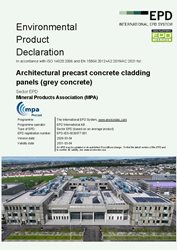
Architectural grey precast concrete cladding panel sector EPD
Architectural concrete cladding panels consist mainly of concrete with steel reinforcement cage and steel fixings. Cladding panels are manufactured with varying heights and widths with a depth of around 150mm on average.
Published: 2026

|
| |
|
|
 |
|
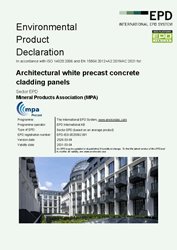
Architectural white precast concrete cladding panel sector EPD
Architectural concrete cladding panels consist mainly of concrete with steel reinforcement cage and steel fixings. Cladding panels are manufactured with varying heights and widths with a depth of around 150mm on average.
Published: 2026
|
|
| |
|
|
 |
|
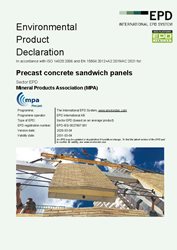
Precast concrete sandwich panel sector EPD
Precast concrete sandwich panels consist mainly of two panels of reinforced concrete with insulation sandwiched between the two layers. Sandwich panels are manufactured with varying heights, widths and depths. Typically the outer precast leaf would be 100mm deep and the inner one would be 150mm. Insulation depth would vary according to type and density. In this EPD, a 240mm deep mineral insulation is assumed.
Published: 2026
|
| |
|
|
 |
|
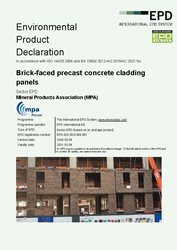
Brick-faced precast concrete cladding sector EPD
Brick-faced precast concrete cladding panels consist mainly of concrete with steel reinforcement cage and steel fixings with mortar and brick slips cast in the exposed surface. The brick slip in the context of this assessment is a mud clay brick cut in half to 50mm thicknesses.
Published: 2026
|
| |
|
|
 |
|
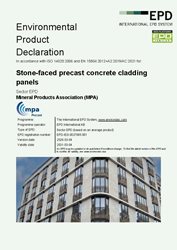
Stone-faced precast concrete cladding sector EPD
Architectural concrete cladding panels consist mainly of precast concrete with steel reinforcement caging and metal fixings. Cladding panels are manufactured with varying heights and widths with a depth of around 150mm on average. 50mm Portland stone is then layed over mortar (20mm) on top of the panels.
Published: 2026
|
| |
|
|
 |
|
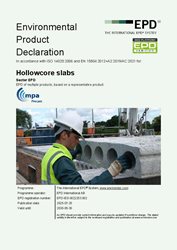
Hollowcore slab sector EPD
Hollowcore slabs (EPD of multiple products, based on a representative product). Hollowcore slabs are made of precast concrete with prestressed strand and wire reinforcement. A typical plank could be 1.2 metres wide and 6-8 metre in length.
Published: 2025
|
| |
|
|
 |
|
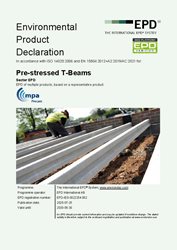
T-beam sector EPD
Pre-stressed T-beams (EPD of multiple products, based on a representative product). The T-beams are made of precast concrete with prestressed strand and wire reinforcement.
Published: 2025
|
| |
|
|
 |
|
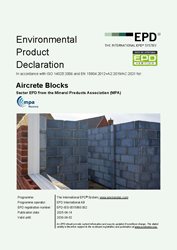
Aircrete blocks sector EPD
The product is aircrete building blocks with an average density of 600.53 kg/ m3 (450 – 850 kg/m3), manufactured to BS EN 771-4. The constituents include CEM I, blended CEM II A-L, quicklime, pulverised fly ash (PFA), anhydrite, paper ash, limestone aggregates, sand, aluminium powder, and water locked in product, in addition to packaging.
Published: 2025
|
| |
|
|
  |
|
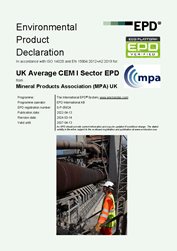
UK Average CEM I sector EPD
This declared CEM I cement is a sector average EPD, modelled using aggregated data from all MPA member sites which manufacture cement. It covers 100% of CEM I produced in the UK.
In the UK, secondary cementitious materials (SCMs), such as Fly Ash or GGBS, are typically added after the cement has left the factory, at the concrete mixing plant.
Published: 2022
|
| |
|
|
 |
|
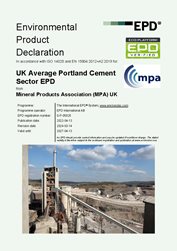
UK Average Portland Cement Sector EPD
This declared Portland Cement is a sector average EPD, modelled using aggregated data from all MPA member sites which manufacture cement. It covers 100% of all factory-made Portland cement types produced in the UK.
In the UK, secondary cementitious materials (SCMs), such as Fly Ash or GGBS, may be added at the cement factory, or after the cement has left the factory, at the concrete mixing plant.
Published: 2022
|
| |
|
|
 |
|
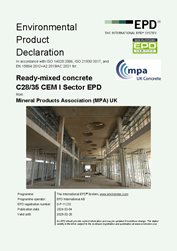
C28/35 CEM I ready-mixed concrete
Ready-mixed concrete is made by mixing coarse and fine aggregates, cement and water in controlled proportions. Chemical admixtures are used to reduce water content and improve fresh and hardened concrete properties. Nearly all foundations, floors and the majority of building structures are made of concrete.
The declared product is 1m3 of ready-mixed concrete specified to C28/35 CEM I, in accordance with BS 8500-2 and BS EN 206.
Published: 2024
|
| |
|
|
 |
|
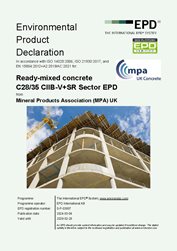
C28/35 CIIB-V+SR ready-mixed concrete
Ready-mixed concrete is made by mixing coarse and fine aggregates, cement and water in controlled proportions. Chemical admixtures are used to reduce water content and improve fresh and hardened concrete properties. Nearly all foundations, floors and the majority of building structures are made of concrete.
The declared product is 1m3 of ready-mixed concrete specified to C28/35 CIIB-V+SR, in accordance with BS 8500-2 and BS EN 206.
Published: 2024
|
| |
|
|
 |
|
C28/35 CIIC-SL+SR ready-mixed concrete
Ready-mixed concrete is made by mixing coarse and fine aggregates, cement and water in controlled proportions. Chemical admixtures are used to reduce water content and improve fresh and hardened concrete properties. Nearly all foundations, floors and the majority of building structures are made of concrete.
The declared product is 1m3 of ready-mixed concrete specified to C28/35 CIIC-SL+SR, in accordance with BS 8500-2 and BS EN 206.
Published: 2024
|
| |
|
|
 |
|
C28/35 CIIIA+SR ready-mixed concrete
Ready-mixed concrete is made by mixing coarse and fine aggregates, cement and water in controlled proportions. Chemical admixtures are used to reduce water content and improve fresh and hardened concrete properties. Nearly all foundations, floors and the majority of building structures are made of concrete.
The declared product is 1m3 of ready-mixed concrete specified to C28/35 CIIIA+SR in accordance with BS 8500-2 and BS EN 206.
Published: 2024
|
| |
|
|
 |
|
C28/35 CIIIB+SR ready-mixed concrete
Ready-mixed concrete is made by mixing coarse and fine aggregates, cement and water in controlled proportions. Chemical admixtures are used to reduce water content and improve fresh and hardened concrete properties. Nearly all foundations, floors and the majority of building structures are made of concrete.
The declared product is 1m3 of ready-mixed concrete specified to C28/35 CIIIB+SR, in accordance with BS 8500-2 and BS EN 206.
Published: 2024
|
| |
|
|
 |
|
MPA Masonry Dense Concrete Block Sector EPD
Dense concrete blocks are comprised of cementitious material, aggregates and water. Dense blocks are manufactured to BS EN 771-3 Dense concrete blocks have a range of applications including, but not limited to, inner and outer leaves of cavity walls, internal partition walls, block and beam floor infill and foundation walls below damp-proof course.
The declared product is 1m2 of dense concrete blocks specified to BS EN 771-3.
Published: 2025
|
| |
|
|
 |
|
MPA Masonry Ultra-lightweight Concrete Block Sector EPD
Ultra-lightweight concrete blocks are comprised of cementitious material, aggregates and water. Ultra-lightweight blocks are manufactured to BS EN 771-3. Ultra-lightweight concrete blocks have a range of applications including, but not limited to, inner and outer leaves of cavity walls, internal partition walls, block and beam floor infill and foundation walls below damp-proof course.
The declared product is 1m2 of Ultra-lightweight concrete blocks specified to BS EN 771-3.
Published: 2025
|
| |
|
|
 |
|
MPA Masonry Lightweight Concrete Block Sector EPD
Concrete blocks are comprised of cementitious material, aggregates and water. Lightweight concrete blocks are manufactured to BS EN 771-3 Concrete blocks have a range of applications including, but not limited to, inner and outer leaves of cavity walls, internal partition walls, block and beam floor infill and foundation walls below damp-proof course.
The declared product is 1m2 of Lightweight concrete blocks specified to BS EN 771-3.
Published: 2025
|